Presence Theatre
  • Home
  • AT PRESENCE
  • Current Projects
  • PLAY READING GROUP
  • The Company
  • Contact
  • SUPPORT PRESENCE
  • Archives
    • Previous projects >
      • Rehearsed Readings
      • INCUBATIONS

R E A D I N G  G R O U P  B L O G 
​(Redux)

​Things to savour about plays we read; and remarks on the readings…

Imagined Realities

24/5/2020

0 Comments

 
Picture

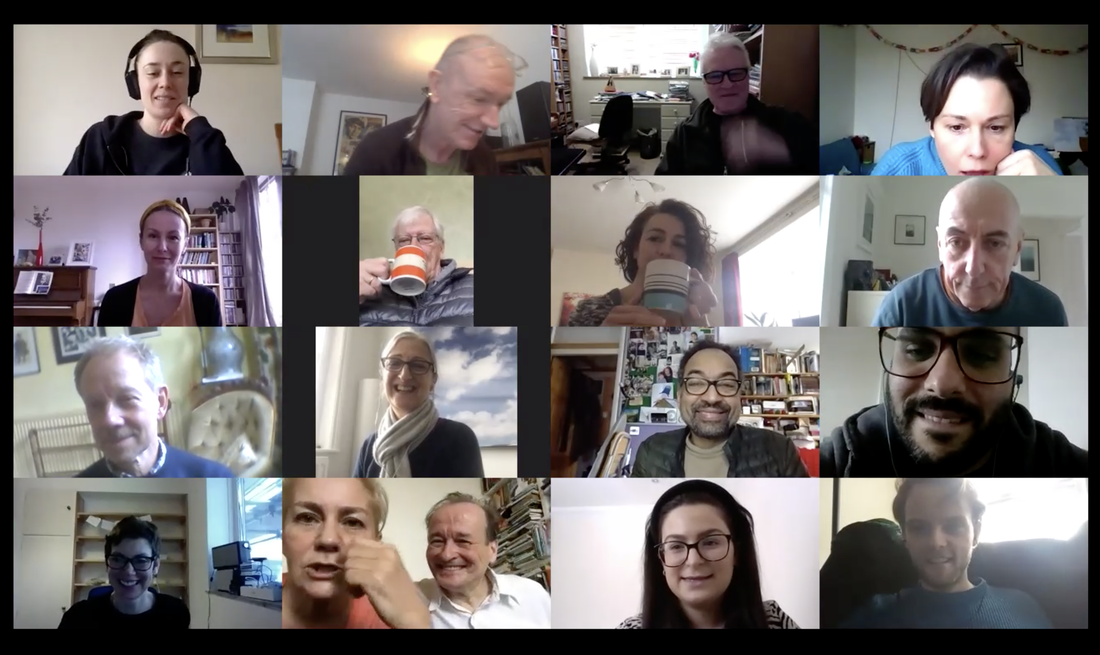
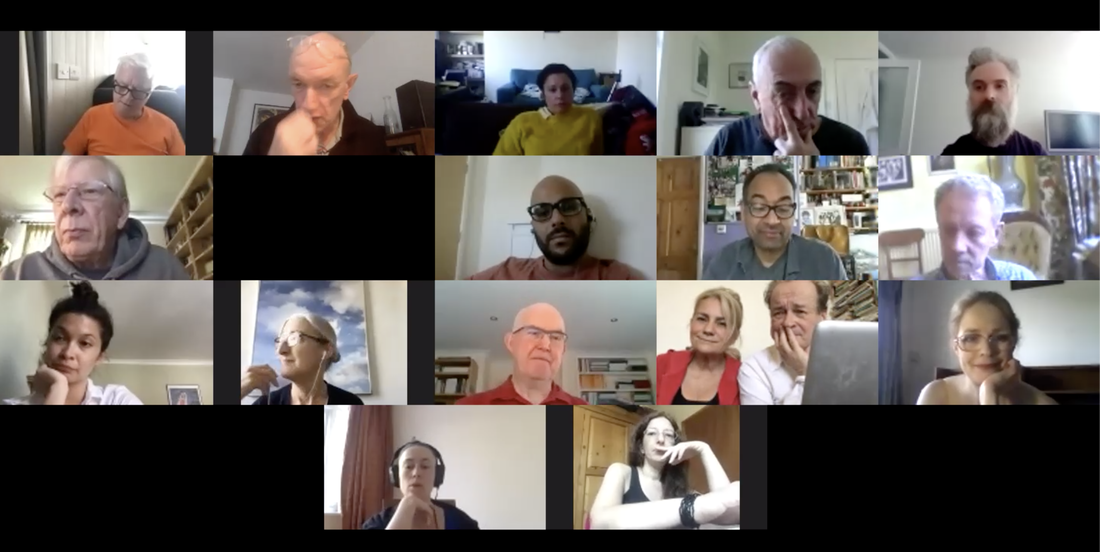
Present (each row from left to right, from top): Sakuntalla Ramanee; Colin Ellwood; Paul Hamilton; Rachel Bavidge; Kevin McMonagle; John Chancer; Emmanuela Lia; Emily Essery; Charlotte Pyke; Susan Raasay; Julia Winwood; Rob Pomfret; Valerie Gogan/Simon Usher

Both of Friday’s (22nd May's) otherwise contrasting plays centrally examined the relationship between the simplicity of inner convictions and the intractable complexity of external realities. According to David Greig’s short 2003 two-hander Being Norwegian, our inner ‘chimes’ can be good, useful, life-affirming and connection-facilitating. Akin in fact to ‘good’ art. By contrast the settled – in fact sclerotic - moral and self-identity-defining convictions of the main character in Odon Von Horvath’s astonishing 1937 Judgement Day induce only isolation, drift, and a tragic inability to respond to unfolding events, with appalling consequences.  Both plays in fact chart their characters’ ultimate shift towards personal and social authenticity, but through apparently opposite means: Greig’s through a mutual, honest investment in a kind of ‘facilitating fiction’, a role play;  Horvath’s through a painful abandonment of all such insulating self-constructions, and of the reassuring fiction that we can accurately attribute individual causality and moral responsibility through simple deployment of our mental ‘operating systems’, rather than through painstaking examination of detailed fact.  Is there any common ground in these plays’ apparently opposite attitude to the ‘assuaging illusion’?  More than at first might appear, since Greig’s  characters’ 'internal fiction' is tacitly acknowledged as such by those who share it and make use of it, while Horvath’s protagonist’s inflexible equivalent functions as a substitute for reality rather than a way of knowingly shaping it. Beguiling cognitive simplifications might be ok, both writers seem to allow, but only if deployed contingently and with self-awareness. More broadly, both Horvath and Greig in writing plays at all are surely themselves tacitly making use of 'acknowledged' fictions to interact with and influence their audience’s reality. And, as we often find in the reading group, sounding these plays in the current zeit-stream induced ripples and echoes that could perhaps influence contemporary thinking, here in Covid-aware and Brexit-beleaguered Britain (and yes I appreciate that that national characterisation is also a gross simplification,  contingent or otherwise…)
 
In the Greig, then, a young woman hooks-up in a bar and goes back to the guy’s run-down flat, discovered  to be littered with boxes of possession still packed after several years' residence. His subsequent awkwardness contrasts markedly with her assured manoeuvring towards sex. The secret of her confidence? Being Norwegian, she says, and Norwegians are straightforward about these things.  His continuing reluctance slowly discovers him as an ex-con hobbled with self-recrimination for having messed up his own and others’ lives. But then we get an inkling that she also might not be what she seemed. Maybe she’s not Norwegian after all?  What ensues suggests that as long as the ‘ontological status’ of the mental construct is acknowledged, playing can be both fun and facilitating.  ‘Norwegian-ality ’ is here a mental tone, a state of mind that unlocks a mutual ability to (in the play, literally) dance. Don’t ‘essentialise’, the play seems to suggest, and especially don’t essentialise your identity if its based on an obvious fiction.  But do feel free to play.  Good news of course for all artists looking to inhabit the mind-set and identity-position of a character different from themselves.  Taking another tack, its difficult not to reflect on the relational efficacy of Greig’s ‘tincture of Norway’ (however inaccurate the character’s sense of Norwegian spirit might be, in their activating of an imaginary and purely mental potentiality) compared to the UK’s own currently rather pungent national ethos…which at times seems more redolent of old socks and rancid union-jack underpants than of midnight sun and silent fjords. However maybe we can rethink our own national software. Clearly, according to Greig a shared community ‘chime’, an imagined group reality is useful…but only a benevolent one, neither unwarrantedly aggrandising nor sentimental; a functional operating system, not a fancy dress outfit disguising a toxic pursuit of atomising self-interest.  Maybe, inspired by Greig’s play, we could think of this as a recourse to a ‘Norway plus plus’ model, but for it to work we’d need to acquire not herd immunity but herd susceptibility, a broad social consensus that the currently-available UK retro-version seems to have no chance of offering. 
 
That UK version maybe feels a bit more like the national spirit abroad in Horvath’s extraordinarily premonitory (it was written in Vienna in 1937) Judgement Day, as embodied by the play’s pivotal figure Thomas Hudetz, the apparently efficient and decent young stationmaster of a small provincial town. Popular locally and apparently a model of traditional German duty and efficiency, he makes a constant show of keeping up appearances. But even his status is in a sense a self-aggrandising fiction: he is the station's ‘master’ but in fact also its only employee. The bigger problem is that living in a town rotten to the core with bad feeling  and small hypocrisies, his show of capability doesn’t involve any meaningful engagement with an increasingly sour and dysfunctional reality. Unhappily married and apparently impotent, an unplanned, lurching encounter with the innkeeper’s desperate-for-affection daughter causes him to miss a signal for the express train, with catastrophic results.
 
As the only potential witness to his mistake, the innkeeper's daughter initially supports his story, just about allowing him to cling to his imagined sense of fundamental decency. Paradoxically their tacit pact seems briefly also to afford them a shared illicit authenticity, but her emerging desire to come clean results in him killing her, apparently while in the grip of a temporary psychosis. His self-identity, his sclerotic sense of his own virtue, must be preserved at all cost. Yet he subsequently refers to the incident as his ‘marrying her’, as if subconsciously at least he regards it as some sort of nihilistic authenticity-seeking death pact. As was tellingly pointed out in the discussion after the reading, this symbolic ‘marriage’ feels almost Lorca-esque in its embrace of death as a kind of simultaneous yearning for and destruction of innocence and honesty. When it looks like the truth of his behaviour will come out, and the town lurches to yet another over-simplistic judgment this time of his culpability for the crash and for her death, he contemplates suicide only in the end to give himself up to face the consequences of what actually happened, in all its multi-faceted, causal-complexity rather than as characterised by his and the town's pre-emptive judgments and imagined realities. The main thing, says Hudetz, is ‘not to judge your self guilty or innocent’.  His – and our – human situated-ness is surely too complex for that. And yet… at the end of the play the wind (‘it’s only the wind’ says the play’s raisonner, the local chemist) howls like biblical trumpets of judgement and  previously ghosts and symbols have increasingly intruded, as if the more reality is denied by the Hudetz, the more it emerges into the play's dramatic world in psychotic dream form, such as in the afore-mentioned  'death/marriage' to the white-clad girl. Horvath wrote the play in light of German and Austrian ‘respectable’ society’s inability to face and combat fascism, a failure driven in part by its own delusions of decency and capability. The extraordinary ambivalence and ambiguity of character-psychology and relationships that Horvath achieves here,  as well as the complex model of causality he contrasts with the townsfolks' endless attempts to judge, simplify and assert, surely offers a model of social dissonance and disfunction as salient now as it was then. 
 
Do lets continue imagining and 'distilling' then - to have recourse to convenient and satisfying fictions - but contingently, never losing sight of the underlying reality. As both Horvath and Greig, from their very different moments and perspectives, might agree

CE

Below, a young Odon Von Horvath
Picture
0 Comments

Freedom and Confinement

19/5/2020

2 Comments

 
Picture
Present (line by line from top left): Oystein Brager; Colin Ellwood; Zara Tomkinson; John Chancer; David Whitworth; Maria Nygren; Emanuella Lia; Julia Barrie; Jamie Newall; Regine Rossnes; Adam Tyler; Sophie Juge; Simon Furness; Hemi Yeroham; Anthony Ofoegbu; Valerie Gogan/Simon Usher; Sakuntala Ramanee

​As sometimes happens, our Friday (15th May) plays unexpectedly discovered common ground. This time the principal common denominator was a focus on women caught between confinement and freedom, questioning the validity of both concepts. For this it was our privilege to be joined by Norwegian friends from Unge Viken Theater: dramaturg and playwright Oystein Brager and two young playwrights whose work we have been exploring in the ‘non-virtual’ world: Regine Rossnes, whose school ‘revenge porn’ drama Exposed was featured very successfully in a combined Holborn reading group session and day-long workshop in those far-distant pre-Covid days of March this year; and Maria Nygren, whose Missing Cat was due for a similar arrangement in April until that became the cruellest month and we all had to retreat to our cramped domestic and virtual confinements. That opportunity still awaits whenever the corona-coast is clear, so it was nice in the meantime to have the chance to read Marie’s earlier Hummingbird, a stark, meditative account of a young woman’s encounters with significant and/or ministering  ‘others’ while an inmate at a psychiatric clinic. The trio of progagonist 'Me's' ‘voices’ (boyfriend ‘Him’; friend and fellow inmate ‘You’ and the ‘Doctor’) might be in her room or in her head, or in some liminal and limbic combination of both (an ambiguity contributing beautifully to a delicate sense of intimacy throughout, as of voices whispering in ‘Me’s’ ear in a dream ). As here evoked, the clinic might be a prison or a necessary retreat; her attendant voices restorative or oppressive. The suicide of Virginia Woolf is evoked, but inconclusively, and the attentions of ‘Me’s’ similarly pronominal ‘voices’ are set against the impersonal ever-present chatter of Wikipedia.  The play has a distilled sadness as well as moments evoking the brutal reality of a suicide attempt, all tempered by gentle pokes at the strange contradictions of being drawn simultaneously towards life and death;  to both containment and nurturing on the one hand and to escape and ‘freedom’ on the other. The hummingbird of the title appears in text from Wikipedia, attributed to no particular voice, so available to be claimed by ‘Me’, or possibly only as a potentially inaccurate external characterisation.   ‘Marie’ ‘appears’ as 'herself' at the play's beginning and end, to claim authorship while denying authority over the action. In the Norwegian schools’ tour of the show she apparently did play herself here (but not, I assume, the more-fictionalised ‘Me’?), and she also read these sections on Friday. This, perhaps above all  was the most interesting and moving aspect of a compelling experience: the ‘moment of dramatization’ of the mysterious relationship between apparently inexpressible private suffering and its contingent objectification as performed drama.  ‘Marie’s’ (the ‘character’s) closing assertion (again invoking Virginia Woolf), gave a beautiful sense of the delicate balance between ‘reality’ and dramatic fiction. Its final line is also perhaps the plays most understated, hard-won but heartening endorsement of life itself: a statement of one who has ‘come through’ (to borrow a phrase from a D.H. Lawrence poem) sufficiently to have written the play, and to be able then to repeatedly witness its enactment as an independent, shared entity:
 
My name is Maria, and it is me who has written this. It is true. It’s also not true. Virginia’s story wasn’t my story. But I was sick. And it’s very hard to talk about it now, hard because, I don't re- member it. I remember particular situations and thoughts I had, but I can't remember how I felt or how I experienced it. It's like a black hole in my memory. Which is why I write. 
And when I talk about it now, I no longer talk about it for myself. I talk about it for others. 
Because I don’t feel like that anymore. 

Next up was Rona Munro’s short two-hander The Basement Flat, set in a world that could have been our own dystopian future or simply a contemporary anxiety dream. A middle-aged, middle-class couple face the new reality of their former lodger become their landlord, stomping around upstairs with a gun, and of their absent now-feral daughter having escaped bourgeois confinement to live out ‘freedom’ in the garden-become-jungle outside along it seems with all the other young people.  After attempting to reach out, the couple slowly retreat into the comforts of denial, tea and the confines of their small flat.  This was a genuinely unsettling, richly imagined half-dream-play capturing our very current sense of imminent societal collapse and loss of bearings. We then concluded a very rich afternoon with another Norwegian script – Jon Fosse’s  brief coda to Ibsen’s The Doll’s House,  Freedom, in which a Nora figure comes back, years later, tired of the discovered bleakness of ‘freedom’ but much too late to reclaim whatever possibly nourishing ‘containment’ she has previously escaped, seeking the equivalent of Marie’s institution and Munro’s couple’s flat….would any return here have a more fulfilling and authentic than either?  We never find out, as her ex-husband has re-married, and all three end up denying any validity to what had gone before.
2 Comments

Social Restrictions amidst a Covert ‘Epidemic’ of Lawlessness

9/5/2020

0 Comments

 
Picture
Present (row-by-row, left-to-right from top): Zara Tomkinson; Colin Ellwood; Sakuntala Ramanee; Rob Pomfret; Jamie Newall;  Adam Tyler; Marta Kielkovicz; Hemi Yeroham; Valerie Gogan/Simon Usher; Lewis Hart, Susan Raasay; John Chancer; Eugenia Caruso; Emmanuela Lia

With our current Covid-provoked social restrictions very much in mind, yesterday’s reading session (8th May) visited another ‘lockdown’ era, one in which the ‘virus’ was very deliberately brewed in illicit stills and with half a nation tacitly or actively engaged in its transmission and the consequent subverting of govt. ‘advice’.  And great to have a nice mix of regular and new members in attendance.
 
A visit to prohibition-era America, then, seen from a very fresh perspective in John Chancer’s new radio script tracing the life and exploits of his great aunt (?) Vi, as she endeavoured to escape the dullness of 1920s rural South Dakota for a life of bootlegging excitement in company with the charismatic and hugely capable ex-war-hero Verne. Wonderfully spare, idiomatic dialogue and a beautifully immediate sense of the social fabric and chime of an extraordinary  ‘moment’, seen free from the ‘peeling lacquer’ of the usual period gangster-noir clichés. Over the course of the afternoon we discovered a richly-evoked community on - and beyond - the edges of the law, but not so far beyond as to seem unreal; a life in the suburbs of the criminal underworld that was very much a variation on ‘legit’ domesticity rather than its colourful but old-movie-inflected opposite.  And at the drama’s heart, a very grown-up, loving story of settled partnership between a man in many ways loyal, principled, reliable and talented, and a woman who was in love both with him and with the illicit excitement he trafficked along with the booze. Vi’s gradual transition from small-town skittishness to a settled work-a-day ambiance of career crime; her nemesis at the hands of the FBI and her subsequent alcoholic death as the addled and incapable concierge of a rural hotel at the hands of her consolational (but far from consoling) third husband, were all intricately and compellingly mapped as a series of very plausible and beautifully-implied, incremental micro-choices and acquiescences on Vi’s part, each involving a moth-like orientation towards light and life.  Very effective also were the contrasting portrayals of Verne’s dodgy coterie of criminal associates and of Vi’s wider 'civilian' family back in the rural Midwest. The latter were presented as being very aware, in a vague ask-no-questions sort-of way, that she and Verne were involved in something majorly nefarious, but seeing as they liked and admired the couple they discretely offered them support and an occasional bolthole, while also benefitting from the compensatory largesse Verne and Vi were able, intermittently, to provide. All of this was realised in the script by means of a deft, allusive, take-no-hostages narrative tilt and with a commendable absence of moral censoriousness.  Perhaps a few unsettling bumps resulting mainly from the script’s ambitious attempt to integrate an early account of then-teenage Vi’s first marriage to the hot-blooded but limited Stanley, who father of her long-suffering daughter Betty, but nothing that couldn’t be steadied, perhaps by the development of the Stanley episode into a slightly more expansive short ‘first act’ (which it surely is worthy of being) as evidence of Vi’s first frustrated attempt at fulfilment, priming her for the arrival in her life of real-deal Verne? Overall, a great afternoon and a wonderful and well-taken opportunity for the group’s American accents and characterisations to get a full-blooded canter out onto the digital prairie (representing – as they turned out to - a very broad geographical range stretching from New Jersey to the Mississippi Delta).  A great bootleg time was had by all, and at the end and in subsequent emails many hopes were expressed that the script make it onto the airwaves or to a wider audience in some other medium soon. Thanks to John (who at the end of the reading came out of virtual-world hiding to admit he had been covertly listening to the performance all along) for allowing us to experience the world of his forebears, especially in such a beautifully turned piece of work, and also to hear afterwards about the true-life family circumstances - and see the photos…..(see below).

Picture
0 Comments

Rage and Transfiguration

4/5/2020

2 Comments

 
Picture
Picture
​Present: Julia Barry, Rachel Bavidge, John Chancer, Colin Ellwood, Simon Furness, Valerie Gogan, Paul Hamilton, Marta Kielkovicz, Kevin McMonagle, Rob Pomfret, Adam Tyler, Simon Usher, Julia Whitwood, David Whitworth
 
One of the best things about the reading group is that participants are discovering the play as they read it aloud. Their response, and the consequent ‘in-process’ fashioning of a performance is therefore largely instinctual and ‘in the moment’. The exhilaration of discovery, and of improvisation, go together. The encounter between actor and text (or role) is almost a collision, and a creative one. Sparks fly, something catches fire, and then the fire can be continually shaped. Not unlike the formal encounter between an actor and a mask: the suddenness, the deliberate 'shock' and the singleness of the moment of ‘recognition’ are necessary to generate the requisite instinctual energy, to provoke bold choices in engagement and realisation. However, here the unfolding text - unlike the mask -continues to provide an ever-evolving flow of new information, allowing the actor to continually modifying the original flame, to pivoting and swerve and re-connect in mid-flight.  And it's not just the text that offers the possibility of  'creative collisions': other actors do too when sharing the same role, as regularly happens, so encouraging the actor to instinctually scope the role's broader coordinates and then to ‘dig deep’ to find something different, something unique, something new from deep within.  Also, older often gets to play younger, female to play male and so on,  so again the ‘connection’ of role with actor can transcend any ‘conventional’ casting. The overall result  can be a tessellated quilt of individual insights, owned, held and imagined communally by the group. And , tellingly, none of it really matters: The stakes are ultimately very low, with little or no audience beyond the participants themselves. All present are equally ‘in jeopardy’, all equally invested in and vulnerable to the ‘game’. People take risks, play, and if things don’t fly, nobody minds. There is an ancient-Greek-derived term: ‘phronesis’, meaning a kind of implicit ‘nous’; a spontaneous in-the-moment ability for measured and canny response based on the instinctual absorption of previous experience and the deployment of a trained intuition. The reading group is an exercise in such 'phronetic’ abilities, amplified by the actors' boldness and willingness to fly. It doesn’t always work out like that, but sometimes it does. As perhaps it did in Friday’s session, even though the range and number involved in the ‘tapestry’ of characters in Simon Stephens’s Rage meant that the plan was for each participants to settle a bit more on a single (or couple of) characters for the duration, rather than split and share roles around as is usual

Rage is Stephens’s response to a production of Elfriede Jelinek’s play of the same name (‘Wut’ in German), itself a response to the Charlie Hebdo shootings in Paris, seen by him in a production by long-time collaborator Sebastian Nübling  (see this live trailer etc. embedded here of a different production at The Deutsches Theater, Berlin): 
https://www.deutschestheater.de/en/programme/a-z/wut/.
Judging by the above, Jelinek’s play is a powerful mix of pure rage, character perplexity and a kind of desperate religious transcendence. Stephens’s response however draws also on a different source: Joel Goodman’s eerily beautiful, painterly, almost-religious photographs of late night New Year revelling in Manchester City Centre: 
https://joelgoodman.net/2016/12/31/press-photographer-2016-viral/new-years-night-revellers/
...in which beauty seems dropped-in like a subliminal image, or arisen from an elemental quality within the action itself. It might partly be this full-spectrum emergent humanity, achieved through  their subjects' 'full-bodied' sheer body-ness, that underwrites their often-made comparison to Renaissance religious paintings. After all, human beings in full spate, fully and unselfconsciously engaged….are beautiful. Put a group of us/them together, in a given space, all fully and momentarily 'erupting’ or hunkering down to action and something very charged happens.  The scenario of Stephens’s play is simple: late New Year’s Eve in a city centre with the characteristics and street names of Manchester. The world is turning and a tapestried flow of apparently continuous but concentrated real-time action arcs in its wake. Young people are the ‘poachers’ of the evening, the hunters, the snufflers for meaning, pleasure, intimacy and transcendence amidst the cracks and fissures of the city and the night. And there is also a smattering of largely phlegmatic ‘gamekeepers’: a quartet of dogged bobbies, a taxi driver, all with their own carefully-incubated issues. SO: lunatics and attendants; incipient nuclear reactions and attenuated carbon rods,  all flaming in the high octane ectoplasm thrown on the flames by dint of the occasion. Given its differing source of inspiration, but also surely a function of Stephens’ hugely infectious big-hearted indie-record lyrical richness, Stephens' Rage is not a simple echo of Wut but rather a conversion of its dark  anger into something (perhaps) richer,  ultimately more uplifting, even borderline transcendant. With him, here, the rage is a calling card, a token of admission, a deferential tipping of the hat to Jelinek, but then, like a good jazz improvisor, Stephens takes Jelinek’s ‘offer’ and transforms it. His  battle-casualties of the night staggering and wandering around the city centre are caught more often in moments of stillness, self-confrontation, mutual support or unexpected intimate connection than in full-on aggressive attack mode. The most extraordinarily offensive (and endlessly-inventively-offensive) invective is sometimes deployed, but more as - in an entirely unsentimental way - a symptom of individual need and lovelessness or childlike need to be naughty, to joyously let rip at the universe, transgressing with whatever ammunition is to hand. Here is a logorrhoeic vomiting to match the very salient actual vomiting; an expulsion of societal toxins rather than a reinforcement of them. As the year turns we witness friends dealing with buried traumas; a girl in a sparkly dresses unexpectedly declares love and then proposes to her best friend; a crack in a nondescript wall offers a glimpse of a kind of localised underworld, a Mancunian Nirvana where the dead frolic in miniature, un-reachable but happy. The city centre has become a magic place for the night. Stephens clearly has huge empathy for all his characters, gamekeepers and poachers alike. All are lovingly fashioned and fettled for their individually-customised apotheoses of excess, their extravagent demonstrations of verbal and physical creativity and their sheer joyous Rabelasian, life-affirming slurpy gusto and verve. By means of their linguistic, physical and emotive abundance, the play manages to be both intimate and extravagantly operatic; realist AND poetically transcendent; a joyous clearing of the societal throat; an alchemic transmutation of rage into dreams.  On Friday the experience of reading the play seemed to bring huge delight to all who were there. The participants - often in this case inevitably more 'mature' than the roles they took of course - brought phronesis in abundance, playing with delicacy, poise, insight and love, as we hope the following short video extract will demonstrate: 
https://vimeo.com/414296771/18f0cc615f
GO TO VIMEO RECORDING OF 'RAGE' EXCERPT
2 Comments

An Epic, Surreal Journey on a Raft across Dreams

24/4/2020

0 Comments

 
Picture
Present:
Helen Budge, Colin Ellwood , Kirsten Foster, Simon Furness-Gibbon, Valerie Gogan, David Hounslow, Emmanuela Lia, Robert Lightfoot, Kevin McMonagle, Jamie Newall, Anthony Ofoegbu, Susan Raasay, Zara Tomkinson, Simon Usher, David Whitworth, Julia Winwood, Hemi Yeroham, Laurie Slade (Guest) ​
For our 3rd-ever Zoom session, this was a full-afternoon’s journey reading Robert Holman's intimate epic Rafts and Dreams from 1991, in which a tale of escape from domestic abuse gets subsumed by almost another narrative entirely, of cataclysmic global flooding. The Tufnell Park house-share of the main characters becomes literally a raft swept by flood waters (which emanate from a hole in the characters’ garden caused by an uprooted tree) via polar regions to equatorial Africa. The survivors – an OCD-suffering army wife, her insecure but loving Sgt. Major husband, and their neighbour, a trainee-doctor whose childhood with a pimp/prostitute mother involved some horrendous abuse recounted here in baroque and disturbing detail – all wrestle with the fallout from both the unfolding aquatic global emergency and from their earlier traumas. They variously overcome or succumb to the latter by means of challenges presented by the former, such as are offered for example by encounters with a live chicken and a decomposing caribou. The former encounter is strikingly and unexpectedly moving, as the OCD sufferer faces and overcomes her fear of contamination when  the raft reaches Africa, by means of physical contact with said chicken when offered it by a local woman suffering from leprosy, apparently as a welcoming gift. Close to an ultimate test for a germaphobe, surely. This is a play that somehow makes the borderline-risible seem inevitable, necessary and telling. Not unlike in a dream, in fact. On their travels the central trio are joined first by the wife of a now-imprisoned solicitor who had repeatedly staged and filmed the student-doctor’s childhood abuse, and subsequently by the precocious teenaged son of an aged C of E Bishop found drifting on a passing ice-flow. The script, after a highly dramatic and determinedly realist opening, amplifies the apparently-random-but-significant ‘feel’ of a dream in regard to its external incident, as if the flood water had cracked open and warped the play's space-time continuum, while the characters themselves continue to behave in a psychologically realist way, taking the various serendipitous arrivals and strange global journeyings almost in their stride, as of course you do in dreams. At the point where the rotting caribou carcass is quietly repurposed as a sail for the raft, you begin to realise the play is even more sneakily subversive than even its ‘flood’ narrative implies. With its characters' realistic mental health issues and admittedly grotesque childhood trauma held in tension with its broader dislocated 'ecological/global/dream' dimension, there is a bold sense of the whole being  disorientatingly ‘out of phase’. But that almost Kafkaesque effect makes the play stick to the unconscious like burrs. The trajectory of the characters’ inner journey is perhaps mirrored/amplified in the over-arching epic travel narrative, transitioning from Arctic cold towards Equatorial warmth, and there is fresh directness and simplicity of statement in the dialogue. Everyone just 'delivers' their back story and their diagnoses of each others psyches in a very stark way which, together with the home-made, equivalently stark feel of the drama as a whole, is at times refreshing. In fact it's as if the play is the dream of the slightly autistic-spectrum Bishop’s son who was found adrift on an ice flow painting the vista before him in oils. Tellingly, despite the human and animal drama in his painting, his main focus is on the colours on display. Latterly he is tacitly adopted by the student doctor and the disgraced solicitor’s wife. Unaware that his unacknowledged new ‘father’ has subsequently walked out of earshot and apparently shot himself rather than face the challenges of living, the boy has what is in effect the play’s final and perhaps ultimately orientating, anchoring statement. This apparent non-sequitur recalls a moment earlier in his life and implies that the play' prevailing sense of  ‘un-moored-ness’ has bee on account of something that has been missing from everyone’s experience all along, a sense of familial love and trust:

At Gatwick, Jo, coming home, my parents were there, and I absolutely surprised myself by rushing straight into their arms. That was it, that's all it was, I was home.

The group's reading overall was careful and measured, everyone sticking with it and feeling their way through, probing constantly, rather as if we were ourselves guardedly crossing a vast, mysterious tundra, sparsely populated with some gloriously exotic fauna. As Oscar Wilde almost said of Wagner, this play had many exquisite moments embedded in some perplexing half-hours. 

0 Comments

'S.A.D. Summers of Princess Diana': a Taste of an Ending.

18/4/2020

1 Comment

 
Check the recording of final scene of S.A.D. Summers below.
​The final few moments of the script, with Princess Diana suffering the execution  the play imagines, as her attendants complain about her and a journalist tries to get quotes from her and take her photos, and her distraught sons look on. In the subsequent final scene, son Henri draws a picture of his imagined aborted sister, and is visited by the ghost of Diana's butler and a previous girlfriend, and the by his brother Guillermo.
reading_s.a.d._summers_-_the_end.m4a
File Size: 8993 kb
File Type: m4a
Download File

1 Comment

A Brilliant New Chilean Take on a Familiar Fairy Tale Story

17/4/2020

1 Comment

 
​
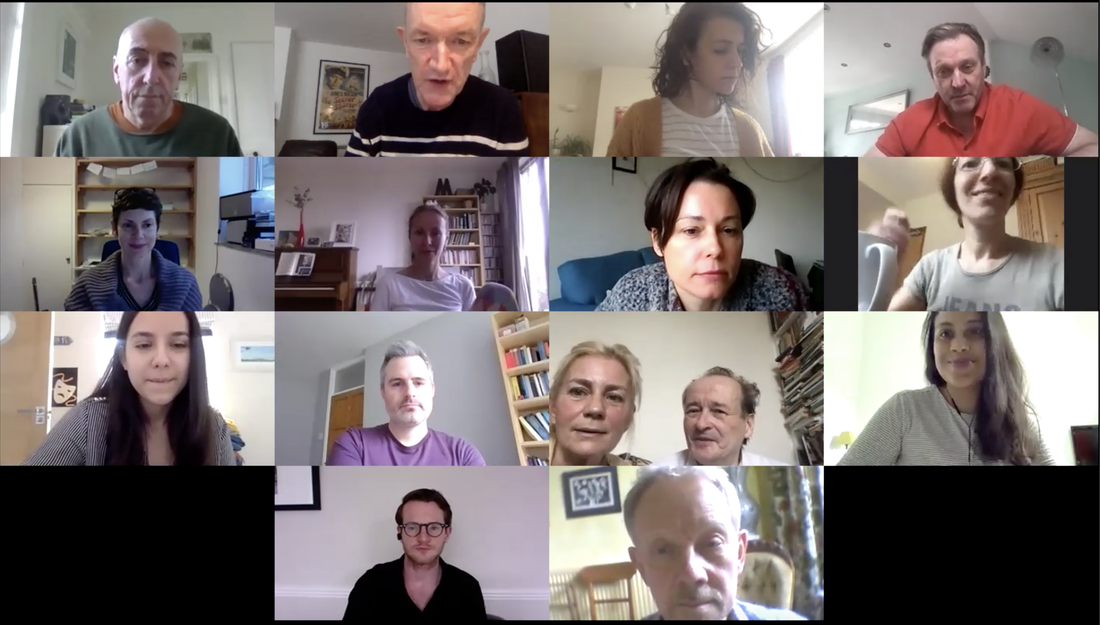
Friday 17th April and with the new limit of 12 participants in the first of what will now be weekly zoom sessions we had a brilliant time with The S.A.D. Summers of Princess Diana, by Chilean playwright Carla Zuñiga, translated by Fran Olivares, who joined us for the reading. This proved a wonderful scrambled, curdled, scabrous fairly-tale/mythical reconceiving of the demise of the the unfortunate princess, complete with sons 'Guillermo' and 'Henri' scurrying across town in furry animal disguise to make contact with the Princess's cross-dressing ex-butler; while viciously censorious retainers 'Brunhilda' and 'Dorothea' 'gaslight' the princess and repeatedly adulterate her meals with dead rodents, aborted animal foetuses and ultimately an amputated human foot.  The palace Fool, after perpetrating possibly the most excruciatingly inappropriate slapstick routine in dramatic literature, is subject to a well-deserved fatal defenestration. Overall shockingly and transgressively funny as well as deeply poignant and heartfelt. And within its dream-distortions,  also a subtle and astute 'outsider' analysis of a deep cultural and social malaise.


Regular group participant Ami Sayers writes:

While we were reading this play on Friday I kept thinking, this is the play I always wish would come out whenever I sit down to write. This has only happened to me with the work of two other playwrights, Sarah Kane and Philip Ridley. Both British, both grotesque yet profoundly poetic in their approach to language, both unafraid of raw, visceral emotion and the power of a strong theatrical image that feels at once like it was scribbled in crayon by a child and by someone with a lifetime of pain and suffering clawing to be let out. Both of these writers are controversial and divisive, in my mind the only way to be as a playwright. 

For me, Carla Zuniga manages to both evoke the work of both of these playwrights and create her own beautifully unique, contemporary voice that feels as relevant and poignant now as it would have done the day after Princess Diana's death. Because it is about Diana yes, but it is not just about Diana. It is about the many, many women like her (and not just women but those who do not fit the mould of what is expected of them by society). It is about Anne Boleyn, it is about Marilyn Monroe, Amy Winehouse, Caroline Flack and countless other 'icons' or 'idols' who have failed to live up to expectations (because how could they possibly). It is about the scrutiny the media places upon such figures- as we see so palpably in the scene between the journalist (who has got herself stuck in the window of the tower Diana is locked inside) when she asks "what would you say to bulimics who are going to read this interview' and Princess Diana replies, echoing King Lear's Cordelia 'nothing'. She is exhausted by this continual scrutiny and intrusion of her life, it is one of the reasons she is 'bulimic' and yet she is being held up and expected to be an icon, a role model to those suffering in the same way. They analyse and scrutinise and tear her apart. Her life is made entertainment, her life is made a moral tale of how a woman should or should not behave, she cannot win. Amy Winehouse could not win, Caroline Flack could not win, they were pushed and pushed and pushed and pushed until they fell, metaphorically, from that tower in which we had imprisoned them. 

There are so many other layers to this exquisite piece of writing, but the above is what hit me in the face, it is what made me shake as I read the first scene out loud, along with other wonderful members of the Presence reading group last Friday. The voice of a woman so profoundly exhausted by what has been thrown at her, by being inside her own skin, by feeling that she is going mad and not knowing whether she really is or whether her cruel, cruel maids are gaslighting her or if indeed it is both- because one is the product of the other. Her sheer exhaustion, her shame, her anger, her pain. 

Her final speech is one that I feel many writers are attempting currently, but none (that I have read) have managed to encapsulate such a strong, angry female voice that still somehow feels relevant to all genders. Despite her biting gnashing anger at the patriarchy, misogyny becomes a human problem that we are all victims of. To write something that does this is no small task, I have tried and failed many a time.

I feel privileged to have been a part of this reading. I wish this play every success in the future. It will raise eyebrows, spark anger, divide audiences. It will be accused, I am sure, of attempting to 'burn down the palace' as Diana commands toward the end of the play. But we need writing like this in the theatre now, we need it, we need it, we need it, we need it.
​


Picture
1 Comment

Reality or Madness….or both? An Expedition with Pirandello into the new Zoom Universe

3/4/2020

0 Comments

 
We ran an exploratory reading group session on Zoom on Friday 3rd April, in which 20 people took part. Our reading of Pirandello's Cosi e (se vi pare)   - translated by Tony Kushner as Absolutely (Perhaps)! - in the end ran for about 3 hours what with chatting at the beginning and a brief break in the middle, and apart from anything else was a very congenial and jolly break from social distancing.  And it was a fascinating and at times very funny play - a farce on the inaccessibility of 'truth' and identity, with its own example of enforced 'social distancing'.  Experiencing it in our current situation felt a bit like gleefully careering round the airy corridors of an abandoned Palladian mansion somewhere on the Campania....  
…a small-town civil servant is either his second wife (the first having died) or his first wife whom he has - deludedly/inadvertently - 'remarried' thinking she is someone else, after she returns to him following a breakdown. The former version of 'reality' is avowed to the curious townsfolk by the civil servant himself, the latter by his mother-in-law. Which one is mad of course depends on which version is true....and deciding that is complicated by the fact that both characters humour each other in their in-law's version of the reality.  Eventually the wife herself appears. But she remains veiled and refuses to confirm either version, preferring to sustain the mystery as a necessary and adequate condition of the family's continuing equanimity. Almost a 'model' of theatre itself, perhaps, as the embodiment of ambiguous stories, the 'truth' of which is irrelevant, provided they are emotionally 'useful' (and even or especially if they are useful to different people in different ways)
All it took to take part was clicking on a forwarded link, and having a device with a camera and microphone. Scripts are forwarded for downloading to second devices if you have such, AND scripts are scrolled across the main screen if you have only one device.
We are already very excited to conduct the next one.

If you are interested in taking part, please contact Colin Ellwood via: [email protected]

Picture
Picture
0 Comments

READING NEW PLAY BY REGINE FOLKMAN ROSSNES

10/3/2020

0 Comments

 
​The Presence Actors’ Monthly Play Reading Group Feb 28th….and beyond.


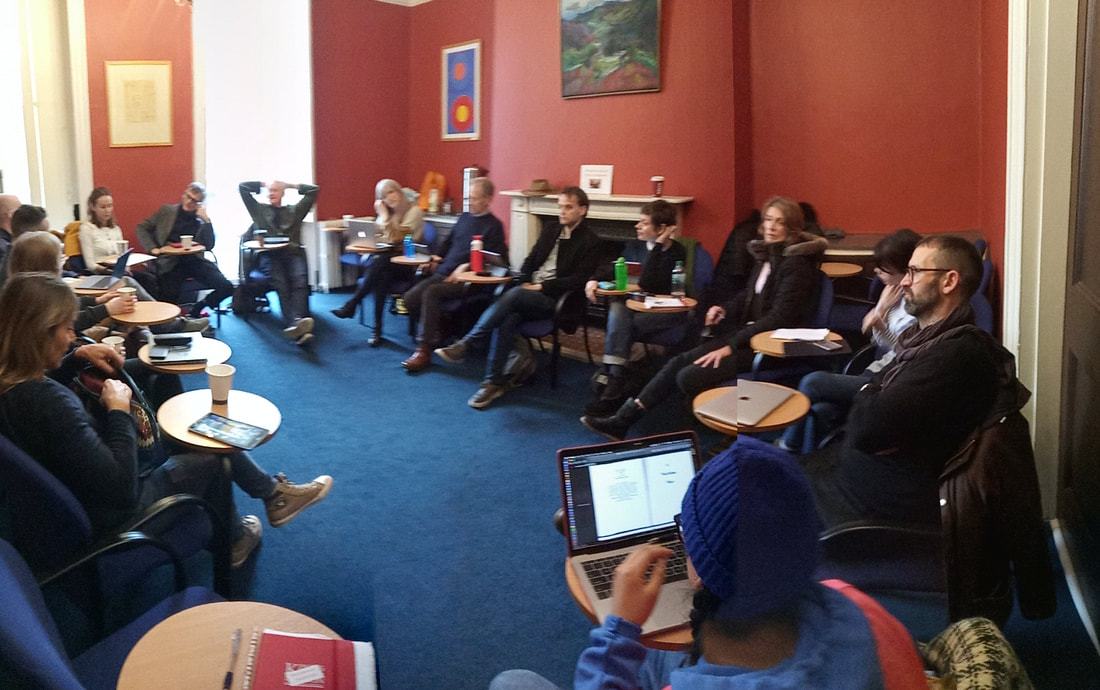
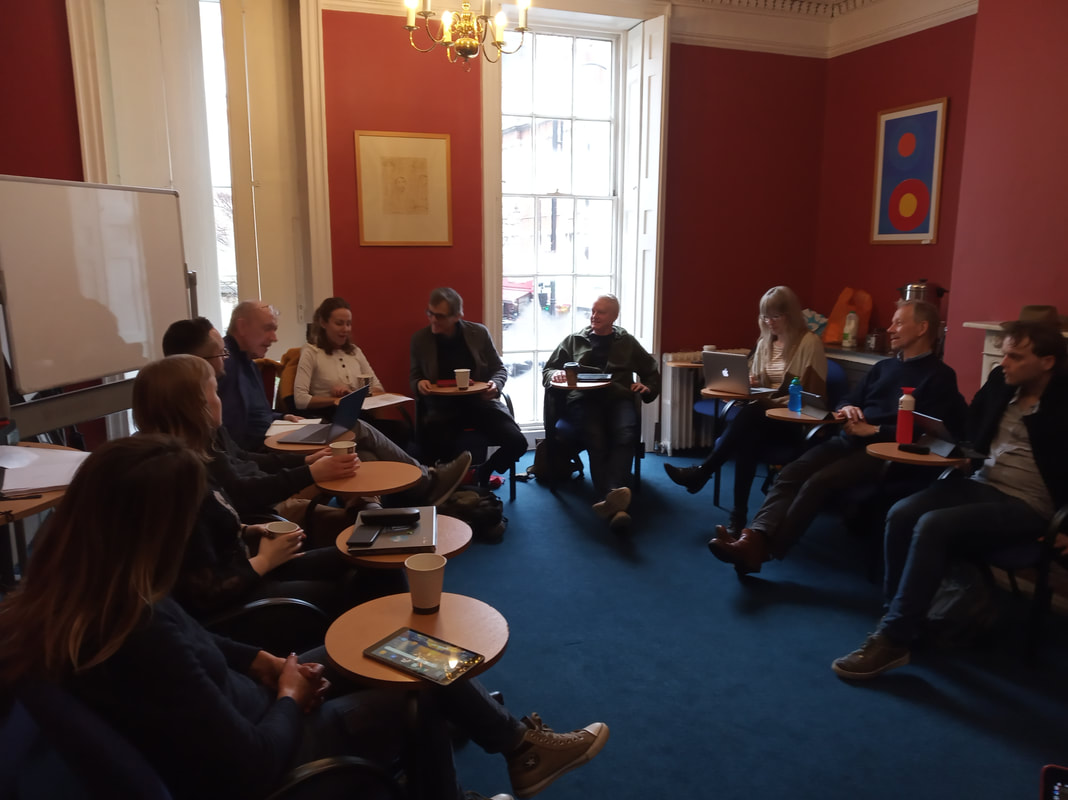
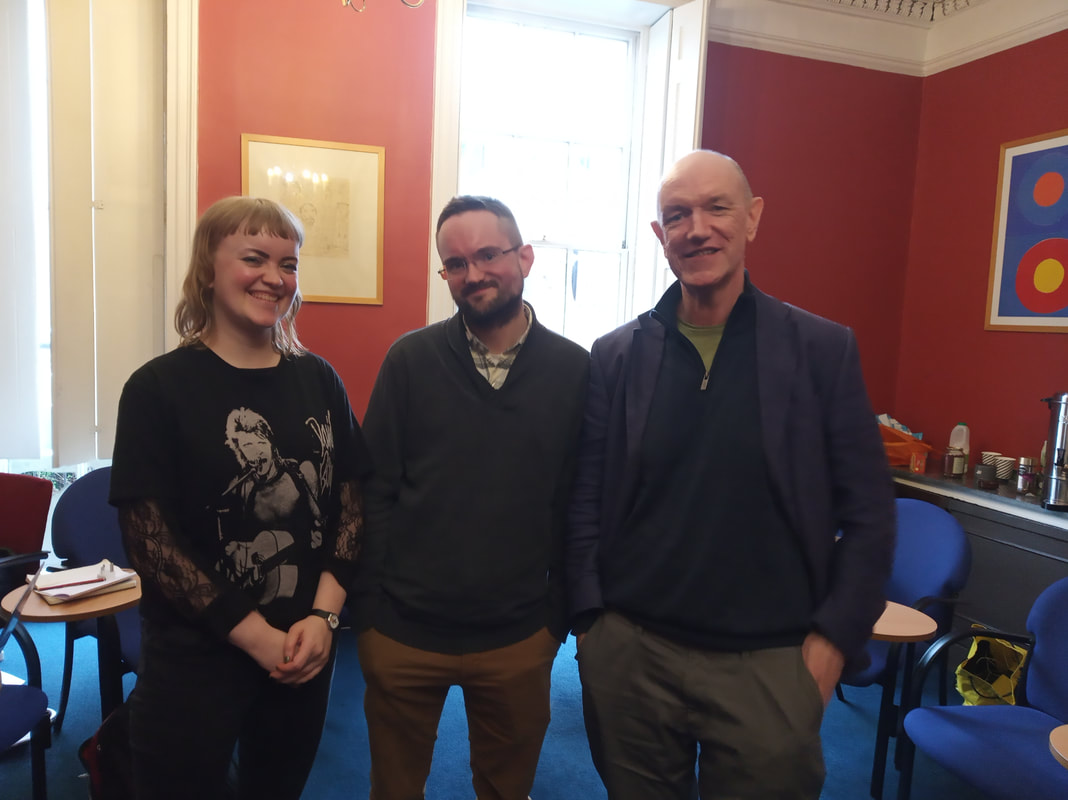
Two great days of script exploration at Presence, this time in partnership with our good friends at Unge Viken Theater in Lillestrom, Norway. On Friday our regular play reading group on at the IES centre in Holborn, welcoming playwright Regine Rossnes and Unge Viken’s dramaturg Oystein Brager to hear Regine’s play Exposed. Then on Saturday heading to Theatre Delicatessen’s brilliant re-purposed space in the City of London for a full day’s exploratory work on the script with performance students from Rose Bruford College


Friday, The Presence Actors’ Play Reading Group


Friday’s session began with an almost-full house of reading group regulars, and with Oystein and Regine from Unge Viken still hurtling along the Piccadilly Line, their early morning flight from Olso having been slightly delayed. While waiting for them we started with Gregory Motton’s 2017 A Worthless Man. It’s a challenging, complex script, and as such warrants close and detailed consideration: The following is not that, but rather preliminary reflections drawn from hearing the play read aloud on Friday.


The play is a series of interweaved stream-of-consciousness monologues: Two families, one working class, one kind-of bohemian bourgeois (both denominations not quite adequate in the plays mapping of a polarising social landscape). Each family consists of a mother, father and just-grown-up daughter, and all are notionally in bed alone in the moments before sleep, remembering their day and reflecting on their relationships with each other and with the wider world.


What begins as class satire, ends in existential despair (or at the most optimistic, as a bleak call to arms). Extraordinarily vivid metaphors bubble into the monologues ultimately threatening to un-seam the fiction, leading us progressively from the astute revelation and pointing of attitudinal absurdity into richer, darker territory. It’s as if the characters, on their way to sleep, become latterly themselves dreamt, and by an imagined consciousness in melt-down, or one achieving a very primary sort of creative clarity. Hieronimo may or may not be mad again.


The father of the more ‘upscale’ family is a marketing executive-cum-college lecturer who deploys management-speak conceits with an impressive but sinister grace. Progressively he is revealed as a demented identity-fascist, striving for a book-burning Year Zero of continual revolution, all history, and all material and biological reality, nullified in the cause of extreme libertarian self-reinvention. All, that is, apart from the ethnic, gender and cultural identities that form the cornerstones of current identity politics, to which he offers a pious obeisance. The contradictions here are clearly part of the satirical point. The mother craves ‘experience’ at any cost (the cost being always on other people’s tabs) up to and including cannibalism; the daughter amuses herself by inventing bizarre self-identities while crassly overriding the obvious and painful material and economic conditions endured by those less fortunate than herself. In fact the whole family in their enormous sense of entitlement are utterly oblivious to the material and cultural resources that underpin their narcissistic gravity-free posturing.


If the play’s posh family strive for continual cultural revolution, the other, or at least its father figure (an ex-miner turned septic tank engineer), dream ineffectually of real political and socio-economic insurrection. For them, the despair is borderline existential and Motton’s portrayal is fundamentally empathetic. The play’s starkest and bleakest metaphors surely belong to this family’s daughter Frizzy, who keens at the meaninglessness of words as an alienating tsunami of bad-faith noise. She likens herself at one point to a self-ravishing nun (not sure that one quiet works, but it somehow does in the play’s almost psychedelic later stages). The insidious and alienating bad faith of language is a key focus throughout, as the satire gradually straitens and dissolves into spectral bleakness, before finally shuddering to a conclusion with a gesture that can only be termed, oxymoronically, sublime bathos.


On Friday the reading began with a savouring of the social satire and absurdity before slowly retracting into something less certain (while maintaining a commendable richness of characterisation and relish of language) as we realised we weren’t in Kansas any more. Surely this is the exact trajectory that any production should seek to induce in the audience, as the sarky anger and subversive mischief of the opening become cut with pain and finally bitter despair. At the end, words kind of failed us (as the play surely prescribes….). Motton might be both Caryl Churchill’s lost dark twin and also possibly her worst nightmare. Chastening.


As we entered the final pages of A Worthless Man, and with immaculate timing, the Norwegians arrived.


Regine Rossnes is a slam poet, and her play Exposed, newly translated with scary slam-aplomb by Neil Howard, is set in a Norwegian high school where new student and free spirit Eili’s sexual indiscretion with her recently-ex boyfriend’s (possibly ‘supposed’ boyfriend’s ) best friend gets uploaded and shared around Snapchat, with devastating effect. If, for Motton, words are simply lies, for Rossnes, they are ultimately valid instruments of expression and potential moral good, and her play accordingly offered a contrast to the near-despair of A Worthless Man. Exposed is a play where moral choices are difficult but conditionally valid, and positive trajectories at least not out of the question. Short stark duologues and trios alternate with slam-poetic interior monologues, embodying a world of intense group loyalties under pressure from new adolescent feelings, experiences and temptations.


The ending of the play offers a positive way forward for the characters that is (deliberately) troubled and troubling, but made possible at all through a central and defining act of bravery and solidarity on the part of the two main ‘wronged’ characters. Calibrating that marginally-positive ambivalence, while also mapping the intense shifting emotions and impulses (in all the characters not just the easier-to-like protagonists) that lie beneath the play’s explicit teenage censoriousness, is surely the play’s central endeavour.


Our reading yielded some fascinating discoveries. Of course this is a spontaneous reading, and expecting full-on emotional availability in such circumstances is of course mad, but perhaps there is also something else going on here. No-one in the group is in the right age range of course (sixteen to eighteen), hence perhaps a slight hesitation to inhabit and internalise the required teenage argot and emotional world. Our culture’s centre of gravity now is arguably the teenager, so the attempt of anyone over the age of twenty to fully commit to a teenage structure of feeling or (related) means of expression maybe feel like an act of aspirational delusion. On the other hand it might be that the teenage ‘identity’ is even more fraught with posturing, self delusion and protective cliche than the ‘adult’ one, and this triggers the reluctance of more world-wise and absurdity-wary adults to engage other than ironically. Or maybe teenaged earnestness – or all earnestness (and teenaged earnestness is surely the purest kind…) - is tricky, in our cynical and wary culture. Anyway, fascinating.


What the reading also reveals, I think, is that beneath the play’s teenaged hedging and posturing (and the play seems to delicately map many such manoeuvrings) lies a well of unconditional, categorical, intense and authentic feelings. It is in fact this ‘charged’ reservoir or root that infuses the script with its poetry (one key strain of poetry surely being by definition instances of simple language and gesture containing or restraining complex, rich, intense ambivalent feeling) and such is evidence in Exposed, as much in the short, terse dialogue exchanges as it its explicitly ‘poetic’ inner monologues. Rendering the former ‘conversational’ (as seemed understandably sometimes the intuitive tactic in the reading) doesn’t quite seem to work. For one thing it disguises the various genuinely (and beautifully defined in the script) failed ‘conversational’ gambits in each exchange that are eviscerated in almost every case by the characters’ emergent deep feeling. For another, it simply dislocates the link to that underlying ‘root’ of feeling that sharpens the exchanges. If the play’s poetic language of the ‘slam’ monologues is about emotional expression, its poetry of the dialogues is about the containment of emotion. Thinking of this ‘teen-spirit’ – expressed AND contained - I kept thinking of the way actors tap into and inhabit the (to us as contemporary adults) in some ways equally ‘alien’ unconditional and emotionally-absolutist worlds of Lorca’s plays or of the Spanish Golden Age writers.


Such clarifications and hunches are of course made possible through the wonderful glittering, ‘tessellating’, multi-faceted and multi-voiced instrument that is the Presence play reading group…


After the reading, a wonderfully energised discussion ensues around the issues arising in the play, such as the ethics of image-appropriation in relation to the demands of ‘old fashioned’ sexual morality; and the crudeness of the tools currently used by adults to manage this kind of teenage behaviour, tools such as the legal system that inappropriately scar both victim and perpetrator in non-proportionate ways. Whatever else the virtues of the play, it absolutely – and necessarily - touches a very sensitive and current cultural nerve.


After a late (and short) lunch we reconvene to read Lucy Kirkwood’s 2012 Royal Court NSWF, in which a ‘lads mag’ publishes a photo of the breasts of a fourteen-year-old girl without checking her age, and her father subsequently arrives at the magazine’s offices. As with Exposed, we have here the exploitation without consent of an underage sexual image, but the lens is very different. Instead of starkness and poetry we have an extremely focused, sharp and very telling satire on hypocrisy and venality. Not unlike the Motton, but with a more defined strategy of attack and without the incipient existential despair. Here the hypocrisies and MOs of the (2012) popular media are used as a way of exposing a society built entirely around the commodification of everything for financial gain: innocence, desire, family relations, the body, intimacy. The third act is set in the offices of a new women’s magazine where similar strategies are deployed: a plague then on both your gender identities… the issues are therefore ultimately posited as being of class and culture rather than gender-related. The play is a riotous read, and with some very deft and clever performances in evidence as the roles circulate round the group. After that, to the pub


0 Comments
Forward>>

    RSS Feed

    ​INDEX of dates:​​
    • WINTER 2021
    • AUTUMN 2020
    • ​SUMMER 2020​
    • SPRING 2020​
    • SPRING 2019
    • SUMMER-AUTUMN 2017
    • AUTUMN 2016-WINTER 2017​
    • WINTER 2015-SPRING 2016
    • SUMMER 2015
    • WINTER-SPRING 2015​
    • AUTUMN 2014
    • ​SPRING-SUMMER 2014​
    ​INDEX of playwrights and plays:
    • Maxwell Anderson: Key Largo
    • Aleksandr Blok: ​The Stranger
    • Edward Bond: Lear
    • ​Dietrich Bonhoeffer: Dramatic Scenes
    • Oystein Brager: ​Cloud Yellow
    • Fredrik Brattberg: ​The Returnings
    • Bertold Brecht: ​Schweyk in the Second World War
    • Helen Budge: ​Grey Collar
    • Joseph Chaikin: ​When the World was Good
    • John Chancer
    • Kia Corthon: ​7/11
    • Noel Coward: Star Chamber
    • ​Don DeLillo: The Day Room
    • Per Olov Enquist
    • Regine Folkman Rosness: ​Exposed
    • Jon Fosse: ​Freedom
    • Julia Gale: ​A Beautiful Room to Die In
    • Griselda Gambaro: Asking Too Much,  Mother by Trade​, Siamese Twins, Whatever Happens Happens, Dear Ibsen, I am Nora, Asking Too Much
    • Carla Grauls: ​Made for Him
    • David Grieg: ​Being a Norwegian
    • Jaroslav Hasek: ​The Good Soldier Schweyk
    • Jacob Hirdwall: Emperor Fukishima
    • Robert Holman: ​A Breakfast of Eels, ​Rafts and Dreams
    • Odon Von Horvath: ​Judgement Day
    • Henrik Ibsen: The Lady from the Sea
    • Jean-Claude Van Italie: ​The Serpent
    • Simon Jaggers: Breaking Horses ​
    • Elfride Jelinek: Wut (Rage)
    • Charlotte Keatley: Emilie's Reason
    • Lucy Kirkwood: NSWF
    • Marie-Héléne Larose-Truchon: ​Midnight
    • ​Maurice Maeterlinck: The Blind
    • Hannah Moscovitch: ​Little One
    • Gregory Motton: ​A Worthless Man ​
    • Rona Munro: ​Basement Flat
    • Maria Nygren: Hummingbird,   Missing Cat
    • John Osborne: ​A Patriot for Me
    • Nick Payne: ​The Frugal Horn
    • Harlold Pinter: ​A Night Out
    • Luigi Pirandello: Absolutely (Perhaps)! ​
    • Gerlind Reinshagen: Sunday's Children ​
    • Friedrich Schiller: Joan of Arc ​
    • Arthur Schnitzler: ​La Ronde
    • Sam Shepard: A Short Life of Trouble, The War In Heaven,  ​When the World was Good​
    • ​Laurie Slade: Supermoon
    • N.F. Simpson
    • Simon Stephens: ​Country Music, ​ Herons, Rage
    • Nis-Momme Stockman: ​The Man Who Ate the World
    • Ramon del Valle-Inclan: Bohemian Lights
    • David Watson: That's What I Call Music
    • John Webster: ​The White Devil
    • ​John Whiting: Saint's Day
    • Oliver Yellop: ​I am Gavrilo Princip
    • Carla Zuniga: ​I'd Rather Be Eaten by Dogs, ​S.A.D. Summers of Princess Diana
    INDEX of articles:​
    • Dellilo Delight (17/3/21)​
    • Country House Catastrophes (17/3/21)​​
    • Key Largo... in need of upping the ante from largo to andante (17/3/21)​
    • Ibsen in the Dolls'/Dog House (22/1/21)
    • Commitment versus Accomodation (22/1/21)
    • An American Primal Moment (22/1/21)
    • Beauty and Terror in the unknown (22/1/21)
    • Schiller - Thriller or Filler? (24/10/20)
    • From Summer to Autumn, from Eden to the Fall (21/10/20)
    • Our 'Summer Season' of Readings (15/9/20)
    • A Season-Concluding Strudel (30/6/20)
    • The Sacred, the Profane and the Reconfiguring of Action (22/6/20)
    • Spartacus and The Butterfly Effect (15/6/20)
    • ​Writing a Forgotten Person (10/6/20)​
    • Fragile Worlds (8/6/20)
    • Contrasting Gender Agendas? (8/6/20)
    • Imagined Realities (24/5/20)
    • Freedom and Confinement (19/5/20)
    • Social Restrictions amidst a Covert ‘Epidemic’ of Lawlessness (9/5/20)
    • Rage and Transfiguration (4/5/20)
    • An Epic, Surreal Journey on a Raft across Dreams by C. E.
    • ​'S.A.D. Summers of Princess Diana': a Taste of an Ending by C. E. 
    • A Brilliant New Chilean Take on a Familiar Fairy Tale Story by C. E.
    • Reality or Madness….or both? An Expedition with Pirandello into the new Zoom Universe by C.E.
    • READING NEW PLAY BY REGINE FOLKMAN ROSSNES by Colin Ellwood
    • A Collaborative Complicity by Charlotte Keatley 
    • ​A Blind Poet and a Blind King Corralled in a Discovery of Chairs by Colin Ellwood (07/10/16)​​
    • ​An Atmosphere of Daring by Gwen MacKeith
    • ​Keeping Afloat by Siubhan Harrison
    • ​Between the Lines by Christopher Naylor 
    • ​Prospecting by Bill Nash 
    • ​Missing Voices by Jamie deCourcey (02/05/15)
    • The Propensity to be Enriching by Danny Horn (19/01/15)
    INDEX of contributors:
    • John Chancer
    • Jamie de Courcey
    • ​Colin Ellwood
    • ​Tom Freeman
    • Valerie Gogan
    • Siubhan Harrison
    • Danny Horn
    • ​Charlotte Keatley
    • Stephanie Königer
    • Gwen MacKeith
    • Caitlin McLeod
    • ​Bill Nash
    • Christopher Naylor
    • Alex Ramon
    • ​Stephanie Rutherford
    • ​Simon Stephens
    • Jack Tarlton
    • Oliver Yellop​
    TAKE ME BACK
Powered by Create your own unique website with customizable templates.
  • Home
  • AT PRESENCE
  • Current Projects
  • PLAY READING GROUP
  • The Company
  • Contact
  • SUPPORT PRESENCE
  • Archives
    • Previous projects >
      • Rehearsed Readings
      • INCUBATIONS